Showing posts with label music. Show all posts
Showing posts with label music. Show all posts
Magnetotron World Debut
I performed with the Magnetotron, my cassette tape-based instrument, at the ITP NIME show at Cameo Gallery in Brooklyn on 12/11. Accompanying me on bass is Kevin Bleich, and Justin Storer on drums.
It was a great time - special thanks to my fellow musicians and the videographers Alex Kozovski, Roopa Vasudevan, and Rose Schlossberg.


Eight Games of Tetris at the Same Time
OctoTetrimino by PushTheOtherButton
A generative piece consisting of eight 2:00 games of Battle Tetris that are perfectly synched. The general strategy of the player dictates the rising and falling action of the piece.
A generative piece consisting of eight 2:00 games of Battle Tetris that are perfectly synched. The general strategy of the player dictates the rising and falling action of the piece.
I Circuit Bent the Hangout Feature In Google+
I'm definitely a big fan of Google+ so far, and yesterday a group of friends and I decided to use it's "Hangout" video chat feature. We thought it would be fun to keep adding more users to find the breaking point.
I think it was after getting 9 people simultaneously video-chatting that the app froze on my Macbook. I refreshed it, and this is what I saw and heard - a tableau of blank faces with soundtrack that sounded like R2D2 with a head cold. I did not know software could be circuit bent, or unintentionally datamoshed. I recorded the sound with my cell phone and did a screen shot of the page, so this fairly accurately recreates what was going on. Enjoy!
I think it was after getting 9 people simultaneously video-chatting that the app froze on my Macbook. I refreshed it, and this is what I saw and heard - a tableau of blank faces with soundtrack that sounded like R2D2 with a head cold. I did not know software could be circuit bent, or unintentionally datamoshed. I recorded the sound with my cell phone and did a screen shot of the page, so this fairly accurately recreates what was going on. Enjoy!
Making a Mouthpiece Fit My Horn
Recently I made an exquisite trade through Craig's list - 5 beat up student violins and a student model trumpet, in exchange for a 90 year old Alto Horn. Since acquiring it I've played it a whole lot.
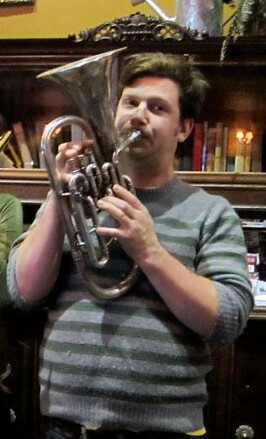
The problem was, the mouthpiece that came with it was for a mellophone, which has a shaft size that's too small for the alto horn. I set about increasing the shaft size instead of holding it together with scotch tape.
First I covered the mouthpiece shaft with a liberal amount of JB-WELD. Initially I thought it would be possible to sand it down by hand to a cylindrical shape, but this proved to be difficult.
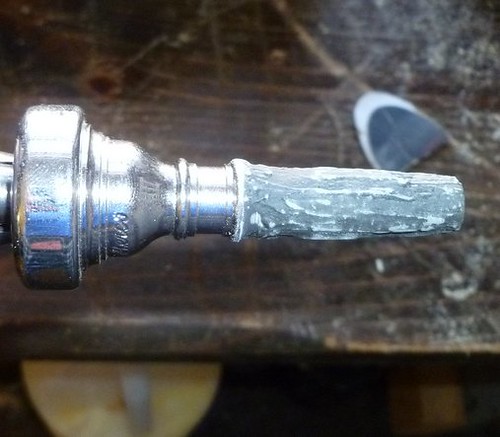
My next idea was to sand while it was turning, as on a lathe. This required finding just the right size bolt and nut to secure the mouthpiece, but once done I was able to mount it in my hand drill. which I then mounted in my bench vise.

Then it was just a matter of sanding it down while the drill ran. I'm quite happy with the results, and glad I didn't have to go out and buy a new mouthpiece.
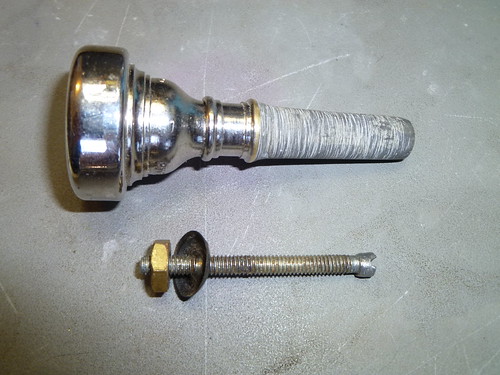
The problem was, the mouthpiece that came with it was for a mellophone, which has a shaft size that's too small for the alto horn. I set about increasing the shaft size instead of holding it together with scotch tape.
First I covered the mouthpiece shaft with a liberal amount of JB-WELD. Initially I thought it would be possible to sand it down by hand to a cylindrical shape, but this proved to be difficult.
My next idea was to sand while it was turning, as on a lathe. This required finding just the right size bolt and nut to secure the mouthpiece, but once done I was able to mount it in my hand drill. which I then mounted in my bench vise.
Then it was just a matter of sanding it down while the drill ran. I'm quite happy with the results, and glad I didn't have to go out and buy a new mouthpiece.
"Bounce Announce" Visualization Element
I've decided to take the Bounce Announce project and add visualization to it utilizing piezo sensors and processing. Every instrument will have a piezo trigger attached to it, that will be processed by Arduino and fed to a Processing visualization sketch.
On a projected backdrop, the effect should appear to be differently colored expanding concentric circles that originate from each impact point.

On a projected backdrop, the effect should appear to be differently colored expanding concentric circles that originate from each impact point.
Test Audio/Video for the "Bounce Announce" Audio Installation
I'll soon be building a sound installation consisting of several hundred (ping pong?) balls in a series of hopper assemblages. At the bottom of each hopper will be a feed tube with solenoids at the end. The solenoids will be triggered by Arduino, and pop out the ping pong balls at prescribed times.
The ping pong balls will bounce sequentially onto carefully placed musical instruments on the floor below, before finally coming to a rest in a cushioned collection area.
The Arduino will be communicating via midi on the computer, and following instructions from a pre-conceived score written specifically for the installation.
Video below is of balls bouncing onto different combinations of instruments, to give an idea of the "Bounce Announce" setup.
Below this is audio I captured from the above video, in layered form, to give an idea of the possibilities of the installation. The final product will hopefully be much wider in scope, with perhaps a dozen solenoids with corresponding instrument arrays.
Bounce Announce Test 1 by PushTheOtherButton
The ping pong balls will bounce sequentially onto carefully placed musical instruments on the floor below, before finally coming to a rest in a cushioned collection area.
The Arduino will be communicating via midi on the computer, and following instructions from a pre-conceived score written specifically for the installation.
Video below is of balls bouncing onto different combinations of instruments, to give an idea of the "Bounce Announce" setup.
Below this is audio I captured from the above video, in layered form, to give an idea of the possibilities of the installation. The final product will hopefully be much wider in scope, with perhaps a dozen solenoids with corresponding instrument arrays.
Bounce Announce Test 1 by PushTheOtherButton
How To Rewire Roland DS90 Speakers (For Humanities Students)
After so many years of literary analysis and myriad other right-brained ventures, I've become quite sluggish in mathematical type analyses. So, when I accidentally blew the internal amplifiers on my Roland DS90 desktop monitors, it took six years of procrastination before I finally opened them up and converted them to passive speakers.
Wiring in series and parallel I could understand, but when it got into the heady world of impedance and frequency crossovers, my brain started to swirl. I'll try to give the condensed version of how I figured it all out.
First, these monitors have two speakers, one standard for all frequencies, and one tweeter for only high frequencies.
A "crossover" is a speaker wired in parallel that has it's frequency limited by wiring in one or more capacitors.
I found out the "crossover frequency" of my speakers, then checked out this site to calculate the proper capacitance
Then it was a matter of rummaging through my junked circuit boards to find the right capacitors. That same site I linked to has a nifty little calculator that tells you how many farad you get when wiring the capacitors in different series or parallel combinations.
Now for the build pics:
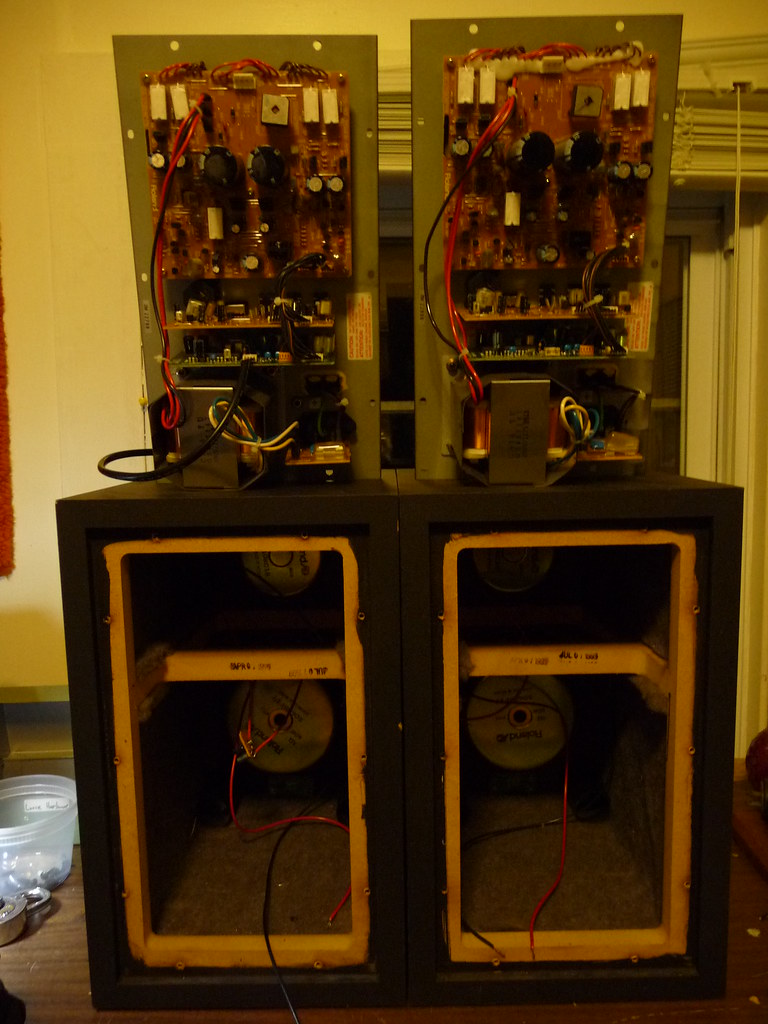
The monitors with their butts ripped off.
 The capacitors wired in: 2 10 microfarad caps in series, and 1 2.2 microfarad cap in parallel = 7.2 microfarad
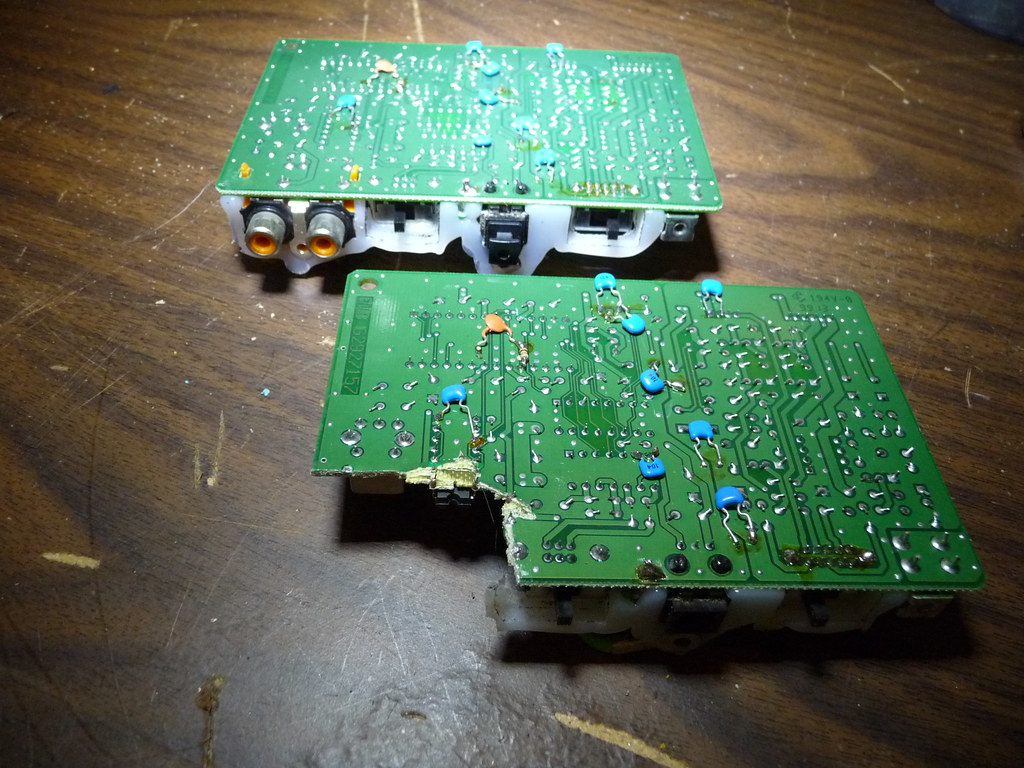 Hacking the input: After I went all Om Nom Nom on the preamp circuit board...
 I used the existing RCA input jack, and kept the rest of the amplifier guts intact, guessing that their physical presence has an effect on the overall sound of the monitors.
Wiring in series and parallel I could understand, but when it got into the heady world of impedance and frequency crossovers, my brain started to swirl. I'll try to give the condensed version of how I figured it all out.
First, these monitors have two speakers, one standard for all frequencies, and one tweeter for only high frequencies.
A "crossover" is a speaker wired in parallel that has it's frequency limited by wiring in one or more capacitors.
I found out the "crossover frequency" of my speakers, then checked out this site to calculate the proper capacitance
Then it was a matter of rummaging through my junked circuit boards to find the right capacitors. That same site I linked to has a nifty little calculator that tells you how many farad you get when wiring the capacitors in different series or parallel combinations.
Now for the build pics:
The monitors with their butts ripped off.
Subscribe to:
Posts (Atom)